
 The Transfiguration of our Lord does not happen in a vacuum. It occurs at a decisive moment in Jesus’ ministry, and the Gospel writers want us to remember what has just taken place.
Peter has confessed the truth: “You are the Christ, the Son of the living God” (Matthew 16:16). He speaks rightly—not because of his own insight, but because the Father has revealed it to him. Yet almost immediately, Peter stumbles. When Jesus explains what it means to be the Christ—that He must go to Jerusalem, suffer, be killed, and rise again—Peter rebukes Him. Such suffering, Peter insists, must never happen.
Why the Transfiguration Comes After Peter’s Confession
Peter wants Christ’s glory without Christ’s cross.
He wants a Messiah who conquers without suffering, who reigns without dying, who saves without blood. And when Peter speaks this way, Jesus responds with words that are sharp and unforgettable: “Get behind me, Satan.” Peter is not merely confused; he is resisting the Word of God. He has set his mind not on the things of God, but on the things of man (Matthew 16:23).
It is after this confession, misunderstanding, and rebuke that Jesus takes Peter, James, and John up a high mountain. The Transfiguration is not a reward for Peter’s insight, nor an escape from the cross Jesus has just announced. It is instruction. It is preparation. It is mercy.
What Is the Meaning of Jesus’ Transfiguration?
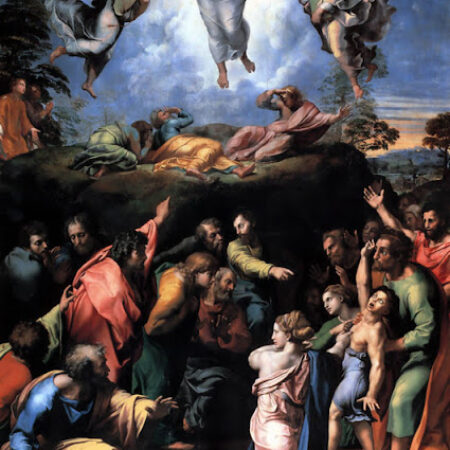
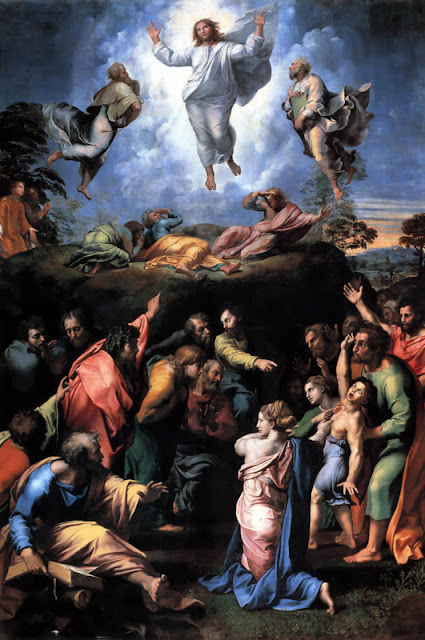
On the mountain, Jesus is transfigured before them. His face shines like the sun. His clothes become white as light. Moses and Elijah appear, speaking with Him. And St. Luke tells us something Matthew does not: they are speaking with Jesus about His departure—literally, His exodus—which He is about to accomplish at Jerusalem (Luke 9:31).
What Moses and Elijah Teach Us About the Cross
This detail is crucial. Even in glory, heaven is not speaking about avoiding suffering. Moses and Elijah—the Law and the Prophets—are not offering an alternative path. They are bearing witness that Jesus must go to Jerusalem, must suffer, must die, and must rise again.
Luther consistently interprets the Transfiguration through this lens. Although he did not leave us a full sermon devoted exclusively to this Gospel, his lectures and theological writings insist that Christ’s glory must never be separated from His suffering. Again and again, Luther warns against seeking a Christ who dazzles without bleeding, who reigns without dying. Even when Scripture reveals Christ’s majesty, Luther teaches us to ask where that glory is leading—and the answer is always the same: toward Jerusalem, toward the cross, toward the salvation of sinners. Glory, for Luther, is not an escape from suffering but its fulfillment in God’s saving plan (cf. Heidelberg Disputation, Theses 19–21; Lectures on Galatians, 1535).
What Peter does not want to hear is precisely what Moses and Elijah are confessing.
“Listen to Him”: Why God Points Us to the Word
Still trying to manage glory, Peter blurts out a plan. He wants to build tents. He wants to preserve the moment. He wants to remain on the mountain rather than descend toward Jerusalem. But while Peter is still speaking, the Father interrupts him. A bright cloud overshadows them, and the voice from heaven declares:
“This is My beloved Son, with whom I am well pleased; listen to Him.” (Matthew 17:5)
The command is not to capture the experience, not to institutionalize the moment, not to chase the feeling—but to hear the Son, especially when He speaks about suffering and the cross.
Why the Disciples Fall in Fear Before God’s Glory
At this, the disciples fall on their faces in fear.
Here we learn something essential. God’s glory, encountered directly, does not leave sinners inspired or empowered; it leaves them undone. Luther often emphasized that when God reveals Himself apart from grace, human beings do not stand tall—they collapse. Divine majesty terrifies. Holiness exposes. Glory unmasks our pride, our fear, and even our religious enthusiasm (cf. Lectures on Galatians, WA 40/1).
“Rise, and Have No Fear”
Then Jesus comes to them. He touches them. And He says, “Rise, and have no fear.”
This is not merely a comforting gesture. It is the Gospel enacted. The same Jesus whose face shone like the sun now stoops down to frightened sinners. The same Lord who stood in heavenly glory places His hand upon trembling men and speaks a word that restores them.
Luther returns to this theme repeatedly: God’s glory is unbearable to sinners unless it is hidden in Christ. Apart from Christ, glory condemns. In Christ, glory saves. God does not remove His holiness, but He mediates it—so that sinners may live (cf. Lectures on John; Galatians).
And just as suddenly as it appeared, the vision ends. Moses and Elijah are gone. The cloud has lifted. Matthew tells us, “They saw no one but Jesus only.” This is not incidental. It is the point. The Law and the Prophets have not vanished into irrelevance, but they now remain only as they testify to Christ. The Father has fixed the disciples’ attention on His Son alone.
Why the Bible Is More Certain Than Religious Experience
As they come down the mountain, Jesus tells them to say nothing about what they have seen until after the Son of Man is raised from the dead. Without the cross and the resurrection, the Transfiguration would only confuse them further.
Years later, Peter reflects on that mountain in his second epistle (2 Peter 1:16–21). He insists that the apostles were eyewitnesses of Christ’s majesty. He heard the voice. He saw the glory. And yet he says something astonishing: “We have the prophetic word more fully confirmed.”
Even that breathtaking experience does not become the foundation of the Church. The foundation is the Word.
This is a point Luther pressed relentlessly. Experiences—even true ones—are unstable. They fade. They vary. They can be misunderstood. But the Word of God stands outside of us. It confronts us. It corrects us. It gives us something firm to cling to when feelings fail and circumstances darken:
“Whatever is without the Word of God is uncertain.”
(Smalcald Articles, III.8)
Peter calls this Word “a lamp shining in a dark place.” Not a floodlight. Not unfiltered glory. But enough light to walk by. Enough to endure until the day dawns and the morning star rises.
What the Transfiguration Means for Christians Today
This is how God has chosen to care for His Church between Christ’s resurrection and His return. Not by constant mountaintop experiences. Not by overwhelming displays of power. But by the steady, external, preached Word.
Luther warned that those who seek God apart from this Word—through inner voices, spiritual impressions, or raw religious enthusiasm—will not find comfort. They will find either despair or delusion. God has bound Himself to His Word so that sinners know where to find Him (cf. Against the Heavenly Prophets, 1525).
And through that Word, Christ still comes to us. He does not demand that we ascend to Him. He comes down to us—in preaching, in absolution, in the Supper. He does not leave us lying face down in fear.
He still says, “Rise, and have no fear.”
Living by the Word on the Road, Not the Mountain
We live not on the mountain, but on the road. Not by sight, but by faith. Not by chasing experiences, but by hearing the Word. And that Word shines for us—even now—in dark places, until the day breaks and Christ’s glory is no longer glimpsed for a moment, but seen forever.
Endnotes
-
Theology of Glory vs. Theology of the Cross
Luther’s fundamental interpretive framework for passages like the Transfiguration is articulated in the Heidelberg Disputation (1518), especially Theses 19–21, where he contrasts a “theologian of glory” with a “theologian of the cross.” Glory, rightly understood, is revealed under suffering rather than apart from it.
https://www.projectwittenberg.org/pub/resources/text/wittenberg/luther/heidelberg.txt -
Christ’s Glory Ordered Toward the Cross
While Luther did not leave a discrete sermon on the Transfiguration, his Lectures on Galatians (1535) repeatedly insist that Christ’s exaltation cannot be separated from His humiliation, and that God reveals Himself savingly only through the cross. This principle governs Luther’s reading of all Gospel texts involving divine glory.
https://www.ccel.org/ccel/luther/galatians -
God’s Majesty Is Unbearable Apart from Christ
Luther frequently emphasizes that sinners cannot endure God’s unveiled majesty. God must be “clothed” in Christ if He is to be approached without terror. This theme appears throughout the Lectures on Galatians and in Luther’s preaching on John’s Gospel.
Galatians Lectures (1535): https://www.ccel.org/ccel/luther/galatians
Sermons on John: https://www.projectwittenberg.org/pub/resources/text/wittenberg/luther/web/johnsermons.html -
The Word Over Experience
Luther’s insistence that faith rests on the external Word rather than on experience, visions, or inner certainty is stated clearly in the Smalcald Articles, Part III, Article VIII (“Of Confession”). This conviction aligns closely with Peter’s claim in 2 Peter 1 that the prophetic Word is more certain than even eyewitness experience.
https://www.bookofconcord.org/smalcald-articles/part-iii/ -
Certainty Found Only in the Word of God
Luther repeatedly warns that anything sought apart from God’s Word is uncertain and spiritually dangerous. This theme is especially prominent in Against the Heavenly Prophets (1525), written against those who privileged inner revelation over Scripture and preaching.
https://www.projectwittenberg.org/pub/resources/text/wittenberg/luther/web/heavenlyprophets.html -
God Binds Himself to External Means
Luther’s teaching that God chooses to deal with sinners through external means—preached Word and Sacraments—rather than unmediated glory or inner revelation is consistent across his confessional and polemical writings. See again the Smalcald Articles and Against the Heavenly Prophets.
https://www.bookofconcord.org
https://www.projectwittenberg.org

0 Comments