
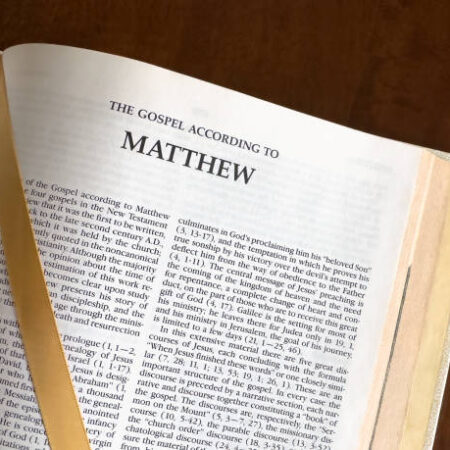
What if Matthew is doing more than telling us what Jesus said and did?
What if he is telling the story of Israel all over again—with Jesus at the center of it?
Our new Sunday morning Bible class will work through the entire Gospel of Matthew with a particular focus on one of the Gospel’s great themes: Jesus as Israel.
Matthew begins with words deliberately reminiscent of Genesis: “The book of the genealogy [genesis] of Jesus Christ” (Matthew 1:1). From there, the pattern begins to emerge.
Jesus goes down into Egypt. A wicked king kills Israel’s children. Jesus is called out of Egypt. He passes through the waters of Baptism. He enters the wilderness and is tested. He ascends a mountain and teaches His people.
Genesis. Exodus. Wilderness. Sinai.
And Matthew is only getting started.
As the Gospel continues, Jesus’ life retraces the history of God’s people. He appears as the greater Moses, Joshua, David, Solomon, Elijah, Elisha, and Jeremiah. Matthew moves us through Israel’s history—from Abraham and the Exodus through the kingdom, exile, and restoration—until everything reaches its climax in Jesus’ death and resurrection.
This isn’t simply a collection of clever Old Testament parallels. Matthew is teaching us who Jesus is.
When Jesus’ family returns from Egypt, Matthew quotes Hosea:
“Out of Egypt I called my son.”
— Matthew 2:15
But Hosea was originally talking about Israel: “When Israel was a child, I loved him, and out of Egypt I called my son” (Hosea 11:1).
Matthew sees the connection because Israel’s story is being taken up and fulfilled in Jesus. Jesus is Israel reduced to One. Where Israel failed, He is faithful. Where Israel rebelled, He obeys. Israel’s calling, promises, kingship, judgment, exile, and restoration all converge upon Him.
But Matthew takes us even further.
Jesus is not merely the faithful Israelite. He is Israel’s God come to save His people.
Matthew begins with Immanuel—“God with us” (Matthew 1:23), and ends with the risen Jesus declaring, “Behold, I am with you always, to the end of the age” (Matthew 28:20).
That beginning and ending tell us what lies between them.
From Genesis to New Creation
Over fourteen weeks, we’ll work through all 28 chapters of Matthew, following the Gospel’s movement through the history of Israel:
Genesis → Exodus → Sinai → Wilderness → Conquest → David and Solomon → Divided Kingdom → Prophets → Exile → Restoration
Along the way we’ll consider questions such as:
Why does Matthew begin with a genealogy? Why does Jesus have to go to Egypt? Why is He tempted in the wilderness? Why does the Sermon on the Mount happen on a mountain? Why does Jesus appoint twelve apostles? Why does Matthew place such emphasis on David and Solomon? Why do Elijah and Elisha seem to stand behind so many events in the middle of the Gospel? Why does Jesus confront Jerusalem and the Temple like Jeremiah? And why does Matthew end on another mountain with Jesus sending His disciples to all nations?
Above all, we’ll keep asking one question:
Where are we in Israel’s story—and what is Jesus doing with that story?
The goal isn’t simply to learn more facts about Matthew. It’s to learn to read Matthew the way Matthew wants to be read—against the backdrop of the Old Testament and centered completely upon Christ.
Matthew begins with Genesis.
It ends with the nations.
And standing at the center of the whole story is Jesus Christ: Son of Abraham, Son of David, Israel’s faithful Son, Israel’s promised King, and Immanuel—God with us.
Join us on Sunday mornings at 8:00am as we work through Jesus as Israel: The Gospel According to Matthew.

0 Comments